


By using this site, you agree to the Privacy Policy and Terms of Use.
Accept
Daily NationDaily NationDaily Nation
  • Home
  • News
    News
    Stay informed with the latest breaking news, in-depth analysis, and exclusive reports from around the world. From politics and global affairs to science, technology, and…
    Show More
    Top News
    Chisenga Katongo urges declaration of ‘Kaunda Day’
    June 20, 2021
    Evelyn Hone launches 2022-2026 strategic plan
    February 24, 2024
    Kafubu Water owed K91m in unpaid water bills by government institutions
    February 25, 2023
    Latest News
    Explain Tayali’s return, Changala demands
    July 20, 2026
    ConCourt petitioned to clarify candidate withdrawals
    July 16, 2026
    Mundubile not arrested, says DEC, trashes social media claims
    July 16, 2026
    ZCCM-IH hires global advisers for listing drive
    July 15, 2026
  • Business
    Business
    Your go-to source for the latest in business, finance, and the economy. Stay ahead with market trends, corporate insights, and expert analysis on entrepreneurship, investments,…
    Show More
    Top News
    China stock swoon could boost US real estate
    March 6, 2025
    Why homeowners are leaving billions on the table
    March 6, 2025
    Lock in now! Stock sell-off sinks mortgage rates
    March 6, 2025
    Latest News
    Sugilite wasn’t stolen – NPA
    July 24, 2026
    CEC Powering Zambia’s Renewable Energy Future and the Journey to 10,000 Megawatts
    July 20, 2026
    Outsourcing can help fulfil job creation promises, says entrepreneur
    July 20, 2026
    BoZ explains delays in Investrust payouts
    July 16, 2026
  • Court News
    Court NewsShow More
    LUSAMBO LOSES BAIL BID AGAIN
    July 26, 2026
    ConCourt petitioned to clarify candidate withdrawals
    July 16, 2026
    Kabesha seeks court clarity on independent candidates
    July 2, 2026
    Court extends Mwamba’s bench warrant
    June 24, 2026
    Over 1000 expatriate teachers sue Gov’t, demand US$1.3bn, K7.5bn
    June 19, 2026
  • Sports
    SportsShow More
    creation.Copper Queens wind up Algeria camp with friendly
    July 22, 2026
    Bernadette Deka Zulu lands top global position
    July 3, 2026
    Immig FC caps dream debut season with trophy presentation to immigration chief
    July 2, 2026
    July 2, 2026
    July 2, 2026
    Foloko underscores Zambia’s active role in efforts to safeguard fair play, transparency in sport
    July 2, 2026
  • Contact
Search
NEWS
  • News
  • Local News
  • Politics
  • Health
  • Court News
  • Tie Business
  • Biz & Corporate
  • Contact Us
  • Privacy Policy
© 2026 Daily Nation Zambia. All Rights Reserved.
Reading: CHINA ALLOWS COUPLES TO HAVE THREE CHILDREN
Share
Sign In
0

No products in the cart.

Notification
Font ResizerAa
Daily NationDaily Nation
0
Font ResizerAa
  • Home
  • News
  • Business
  • Court News
  • Sports
  • Contact
Search
  • News
  • Local News
  • Politics
  • Health
  • Court News
  • Tie Business
  • Biz & Corporate
Sign In Sign In
Follow US
© 2026 Daily Nation Zambia. All Rights Reserved. Developed by GOPES.
📖 Read ePaper
Daily Nation > Blog > News > CHINA ALLOWS COUPLES TO HAVE THREE CHILDREN
News

CHINA ALLOWS COUPLES TO HAVE THREE CHILDREN

Daily Nation
Last updated: May 31, 2021 12:15 pm
Daily Nation
Share
6 Min Read
SHARE

China has announced that it will allow couples to have up to three children, after census data showed a steep decline in birth rates.

Contents
How are people reacting?What did the census say?What were China’s previous policies?Can China lift birth restrictions entirely?

China scrapped its decades-old one-child policy in 2016, replacing it with a two-child limit which has failed to lead to a sustained upsurge in births.

The cost of raising children in cities has deterred many Chinese couples.

The latest move was approved by President Xi Jinping in a politburo meeting, state media said.

It will come with “supportive measures, which will be conducive to improving our country’s population structure, fulfilling the country’s strategy of actively coping with an ageing population and maintaining the advantage, endowment of human resources”, Xinhua said.

How are people reacting?

“If relaxing the birth policy was effective, the current two-child policy should have proven to be effective too, ” Hao Zhou, a senior economist at Commerzbank, told Reuters.

“But who wants to have three kids? Young people could have two kids at most. The fundamental issue is living costs are too high and life pressures are too huge.”

Zhiwei Zhang, chief economist at Pinpoint Asset Management, told the same agency that the immediate impact “is likely to be positive but small”.

“The long term impact depends on if the government can successfully reduce the cost for raising children – particularly education and housing,” the economist added.

- Advertisement -
Ad imageAd image

On social media, some Chinese people also seemed less than excited about the new measures.

“[We can have] three kids, but the problem is I don’t even want to have one,” said one social media user on micro-blogging site Weibo.

  • Why don’t Chinese women want more babies?

“Do you know most young people already find it so exhausting to take care of themselves?”

One Beijing resident who spoke to the BBC ahead of the announcement echoed these thoughts, saying she wanted to “live my life” without the “constant worries” of raising a child.

What did the census say?

The census, released earlier this month, showed that around 12 million babies were born last year – a significant decrease from the 18 million in 2016, and the lowest number of births recorded since the 1960s.

The census was conducted in late 2020 where some seven million census takers had gone door-to-door to collect information from Chinese households.

Given the sheer number of people surveyed, it is considered the most comprehensive resource on China’s population, which is important for future planning.

It was widely expected after the census data results were released that China would relax its family policy rules.
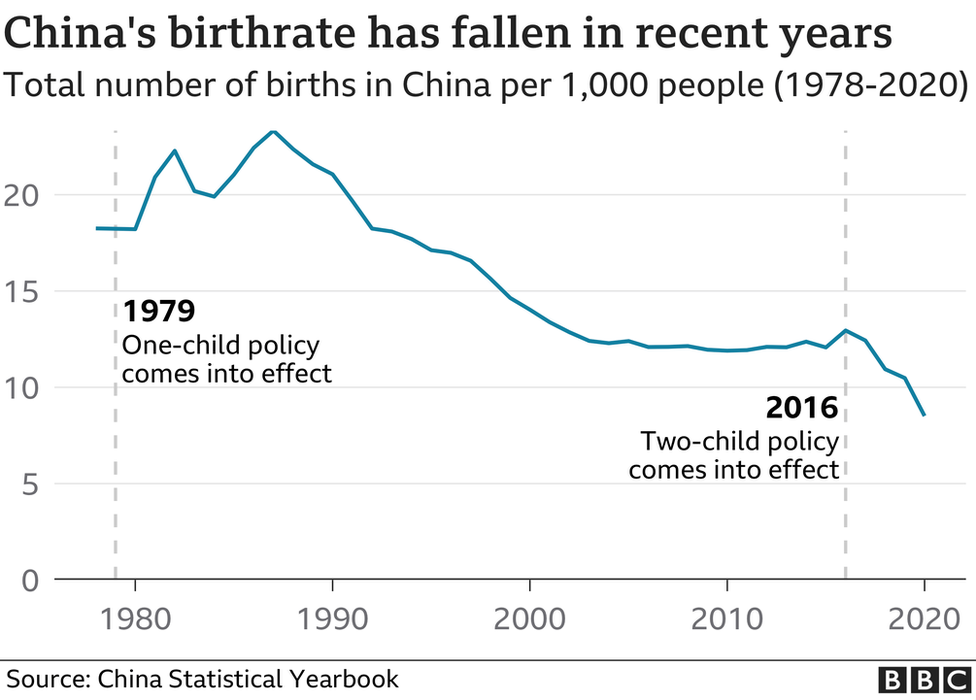
Graph showing China's falling birth rate

What were China’s previous policies?

Even in 2016, when the government ended its controversial one-child policy and allowed couples to have two children, it failed to reverse the country’s falling birth rate despite a two-year increase immediately afterwards.

Ms Yue Su, principal economist from The Economist Intelligence Unit, said: “While the second-child policy had a positive impact on the birth rate, it proved short-term in nature.”

China’s population trends have over the years been largely shaped by the one-child policy, which was introduced in 1979 to slow population growth.

Families that violated the rules faced fines, loss of employment and sometimes forced abortions.

The one-child policy also led to a severe gender imbalance in the country – in a culture that historically favours boys over girls.

“This poses problems for the marriage market, especially for men with less socioeconomic resources,” Dr Mu Zheng, from the National University of Singapore’s sociology department, said.
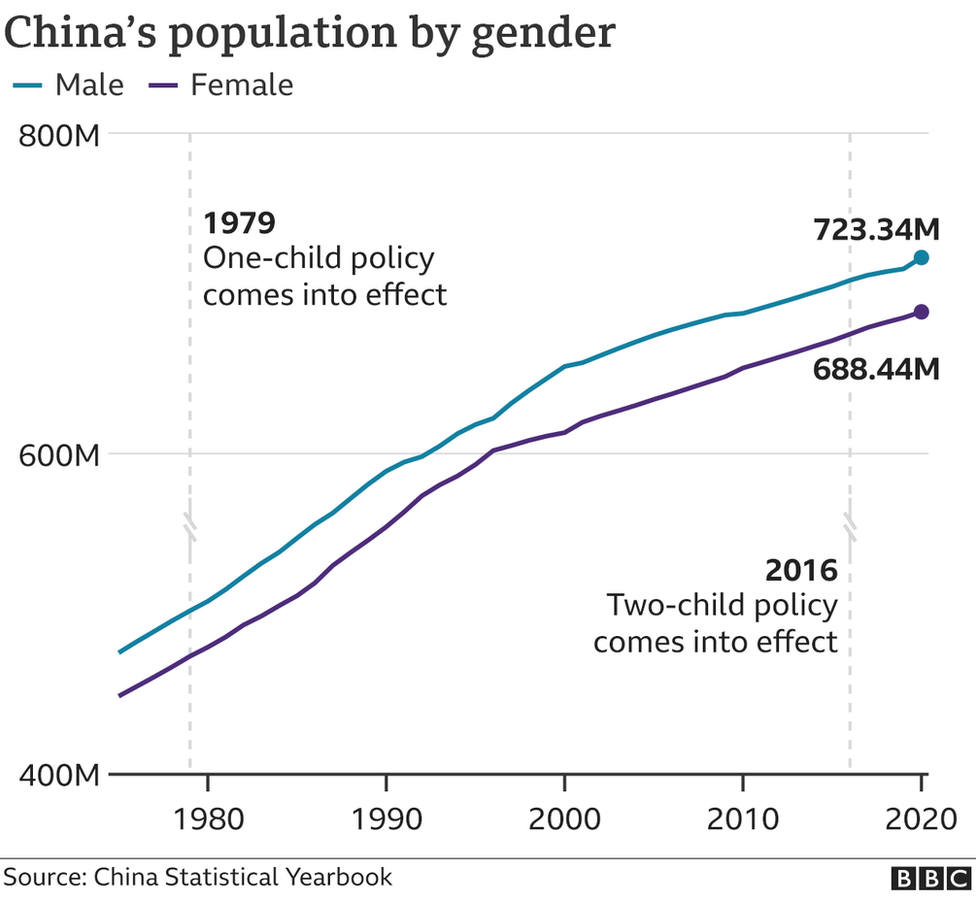
Graphic

Can China lift birth restrictions entirely?

Experts had ahead of China’s latest census, speculated that birth restrictions might be lifted entirely – though it appears as though China is treading cautiously.

But others had pointed out that such a move could potentially lead to “other problems” – pointing out the huge disparity between city dwellers and rural people.

As much as women living in expensive cities such as Beijing and Shanghai may wish to delay or avoid childbirth, those in the countryside are likely to still follow tradition and want large families, they say.

“If we free up policy, people in the countryside could be more willing to give birth than those in the cities, and there could be other problems,” a policy insider had earlier told Reuters, noting that it could lead to poverty and employment pressures among rural families.

Experts had earlier warned that any impact on China’s population, such as a decline, could have a vast effect on other parts of the world.

Dr Yi Fuxian, a scientist at the University of Wisconsin-Madison, said: “China’s economy has grown very quickly, and many industries in the world rely on China. The scope of the impact of a population decline would be very wide.”

You Might Also Like

Ndola-Lusaka dual carriageway deal fraudulent – Dr Frank Ng’ambi

I DIDN’T COMMIT TERRORISM – ZUMANI 

Diesel pump price up by K6.5

STATE HOUSE RUBBISHES STATE CAPTURE GOSSIP

MONZE RESIDENTS REJECT MWIIMBU, PROTEST

Sign Up For Daily Newsletter

Be keep up! Get the latest breaking news delivered straight to your inbox.
By signing up, you agree to our Terms of Use and acknowledge the data practices in our Privacy Policy. You may unsubscribe at any time.
Share This Article
Facebook Copy Link Print
Previous Article EDGAR LUNGU IS A DEVELOPMENT CANDIDATE
Next Article UPND DEMANDS LEVEL PLAYING FIELD

Stay Connected

235.3kFollowersLike
69.1kFollowersFollow
56.4kFollowersFollow
4.4kFollowersFollow
- Advertisement -
Ad imageAd image

Latest News

LUSAMBO LOSES BAIL BID AGAIN
Court News Local News Premium
July 26, 2026
NRPUP Questions ECZ Over Ballot Paper Handling Procedures
Politics Premium
July 25, 2026
ECZ TO PROMOTE INCLUSIVE ELECTORAL PARTICIPATION  
Premium
July 25, 2026
Sugilite wasn’t stolen – NPA
Business Premium
July 24, 2026
//

We influence over 2 million readers and are the most preferred news platform in Zambia.

Quick Links

  • Politics
  • Court News
  • Health
  • Millennium TV

Top Categories

  • News
  • Local News
  • Politics
  • Health
  • Court News
  • Tie Business
  • Biz & Corporate

Sign Up for Our Newsletter

Subscribe to our newsletter to get our newest articles instantly!

Daily NationDaily Nation
Follow US
© 2026 Daily Nation Zambia. All Rights Reserved. Developed by GOPES.
  • Contact Us
  • Privacy Policy
Join Us!
Subscribe to our newsletter and never miss our latest news, podcasts etc..
Zero spam, Unsubscribe at any time.
Welcome Back!

Sign in to your account

Username or Email Address
Password

Lost your password?