
By using this site, you agree to the Privacy Policy and Terms of Use.
Accept
Daily NationDaily NationDaily Nation
  • Home
  • News
    News
    Stay informed with the latest breaking news, in-depth analysis, and exclusive reports from around the world. From politics and global affairs to science, technology, and…
    Show More
    Top News
    BAN CAMPING IN DANGEROUS SPITS – NGWIRA
    January 5, 2022
    HH FRUSTRATED
    July 19, 2021
    Doctors decry falling medical education standards
    April 10, 2024
    Latest News
    Stop the barbaric, violent political skirmishes – HRC
    August 7, 2026
    Zambians want second liberation – Mundubile
    August 5, 2026
    Capital markets key to SME funding – SEC
    August 4, 2026
     HH is President, should avoid street language – Mundubile
    July 29, 2026
  • Business
    Business
    Your go-to source for the latest in business, finance, and the economy. Stay ahead with market trends, corporate insights, and expert analysis on entrepreneurship, investments,…
    Show More
    Top News
    China stock swoon could boost US real estate
    March 6, 2025
    Why homeowners are leaving billions on the table
    March 6, 2025
    Lock in now! Stock sell-off sinks mortgage rates
    March 6, 2025
    Latest News
    HH directs Mopani, KCM to prioritise youth contracts
    August 5, 2026
    KCM pledges continuity in cultural preservation investment
    August 4, 2026
    EIZ sees investor boost from global recognition
    August 4, 2026
    World Bank urges reforms to unlock private sector growth
    August 4, 2026
  • Court News
    Court NewsShow More
    Shoppers can now pay with their mobile wallet at Zambia’s largest retailer 
    August 3, 2026
    LUSAMBO LOSES BAIL BID AGAIN
    July 26, 2026
    ConCourt petitioned to clarify candidate withdrawals
    July 16, 2026
    Kabesha seeks court clarity on independent candidates
    July 2, 2026
    Court extends Mwamba’s bench warrant
    June 24, 2026
  • Sports
    SportsShow More
    Flying Fish extols FIFA World Cup final experience
    July 28, 2026
    Eam Zambia boxers advance with 3 victories in Glasgow Games
    July 28, 2026
    creation.Copper Queens wind up Algeria camp with friendly
    July 22, 2026
    Bernadette Deka Zulu lands top global position
    July 3, 2026
    Immig FC caps dream debut season with trophy presentation to immigration chief
    July 2, 2026
  • Contact
Search
NEWS
  • News
  • Local News
  • Politics
  • Health
  • Court News
  • Tie Business
  • Biz & Corporate
  • Contact Us
  • Privacy Policy
© 2026 Daily Nation Zambia. All Rights Reserved.
Reading: BOOK REVIEW: A HISTORY OF THE UNGA PEOPLE OF THE BANGWEULU SWAMPS
Share
Sign In
0

No products in the cart.

Notification
Font ResizerAa
Daily NationDaily Nation
0
Font ResizerAa
  • Home
  • News
  • Business
  • Court News
  • Sports
  • Contact
Search
  • News
  • Local News
  • Politics
  • Health
  • Court News
  • Tie Business
  • Biz & Corporate
Sign In Sign In
Follow US
© 2026 Daily Nation Zambia. All Rights Reserved. Developed by GOPES.
📖 Read ePaper
Daily Nation > Blog > Lifestyle > BOOK REVIEW: A HISTORY OF THE UNGA PEOPLE OF THE BANGWEULU SWAMPS
Lifestyle

BOOK REVIEW: A HISTORY OF THE UNGA PEOPLE OF THE BANGWEULU SWAMPS

Daily Nation
Last updated: October 11, 2021 3:02 pm
Daily Nation
Share
6 Min Read
SHARE

By Namwanja Margaret Chikwabi

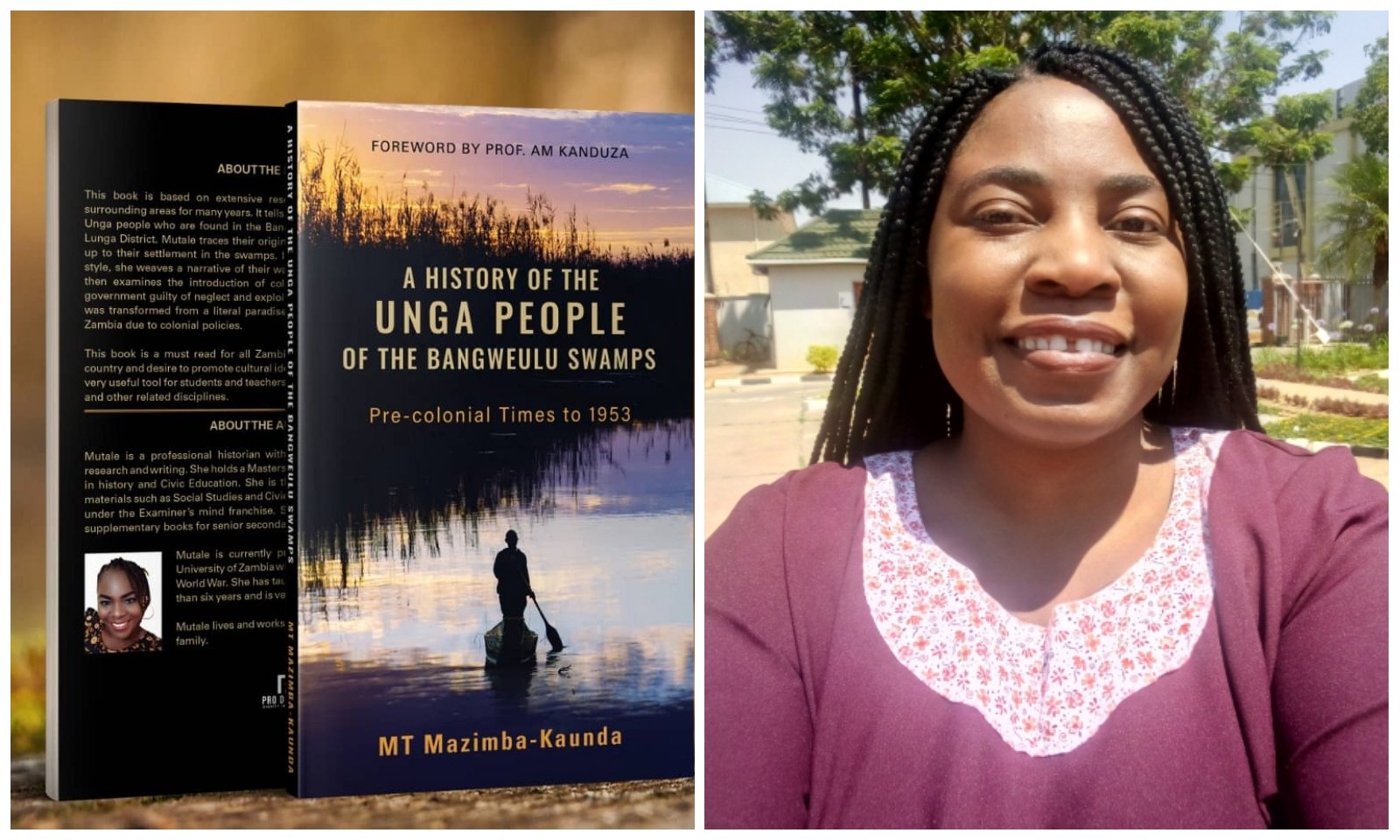
Historian and educator Mutale T. Mazimba-Kaunda (MA) has crafted a fascinating and eye-opening read in A History of the Unga People of the Bangweulu Swamps (pre-colonial times to 1953). She takes us on a sweeping journey through time of this small ethnic group called the Unga who inhabit part of Luapula Province in northern Zambia. In the book, Mazimba-Kaunda delves into pre-colonial Unga society, the colonial experience of the Unga from 1890 and lastly, the impact of colonialism on the Unga people until 1953.

So, who are the Unga and where did they come from? Originally, the Unga were a branch-off of a large family of the Ng’oma totem (drum clan), separating due to the desire for autonomy by adult males. They came from ancient Kola in present-day Kabongo, Shaba Province in the Democratic Republic of Congo (DRC). Their movement to present-day Bangweulu swamps was over several years and they travelled in different groups well into the 17th Century. Their initial language was likely a Luba one, but their migration resulted in them speaking a variation of Bemba with distinct intonation and phrasing.

Economically, the Unga sustained themselves by hunting lechwe for food, otters for fur, crocodiles and snakes for their skins. fishing and growing crops like cassava and sweet potatoes. They also reared sheep, goats and cattle.

Family ancestry in Unga society was traced through the female members of the family, much like the Bemba and Bisa who were/are also mainly found in northern Zambia. The matrilineal system had socio-political implications when it came to succession. For example, when a king died, power was passed onto his brother and in case he had no brother, it was passed onto his sister’s son. The king’s sons could never reign, only the sons of the women of royal blood and these woman were called Namfumu (mothers of kings).

All children bore the name and clan of the mother and not the father. The history leant and institutions carried from generation to generation were of the woman. However, property and titles still went to men born from the female side of the family. Men inherited from their mother’s brothers and passed on their possessions to their sister’s children. Property ownership and inheritance in the context of marriage had its own rules.

By 1900, the British colonial state was imposed on the Unga people after the two most powerful kings within their proximity, Chitimukulu and Mwata Kazembe, were subdued. Native Commissioners were employed to tour districts and collect taxes. Mazimba-Kaunda makes the point that the Unga people resisted paying taxes for many years as a way of protesting colonial rule. Some of them ended up working in the Copperbelt and Katanga mines as wage labourers. Otters were accepted as tax, lechwe were hunted on a commercial basis, and fish trading became big business, all for the benefit of the British government through the British South African Company. On page 83, the author writes: “When a census was carried out in 1907, there were 2,500 Unga people living in 800 taxable huts.”

This book A History of the Unga People of the Bangweulu Swamps (pre-colonial times to 1953) is a significant and quality piece of work. This is evidenced from the clarity and depth with which the author writes and from the sources used to craft it: district notebooks, written material from the National Archives of Zambia, interviews, colonial office reports, e-books, articles, dissertations, unpublished works, etc. Accompanying maps, tables, illustrations and a bibliography make the book come alive because they add context and realness to what is presented on the way of life of the Unga people and how colonialism negatively affected them up until 1953.

Mazimba-Kaunda makes the point in her introduction that the last book written about the history of the Unga was over eighty years ago and was written by a foreigner. The case is, therefore, easily made for the importance of the Zambian storyteller to be the active agent in telling the nation’s diverse stories and preserving the country’s history and culture through the written word. That such type of an undertaking should be encouraged, supported and applauded cannot be emphasized enough.

- Advertisement -
Ad imageAd image

There is much to appreciate in this richly detailed and eye-opening book, such as the formation of chiefdoms in Unga society, the spirituality of the Unga, how they related to other ethnic groups in their vicinity, the role they played in World War I and World War II, and how the World Economic Depression of 1929-1939 affected their economic sustainability, among other topics. If you love history, if you are into promoting or learning about culture, if you’re a student or teacher of history, this book is for you.

Genre: History

Year of publication: 2021

Number of Pages: 185

ISBN: 978-9982-18-323-9

Publisher: Lead First Publishers

Point of Sale: Bookworld, Lusaka Museum, Lead First (+260979369836)

You Might Also Like

DRUG SHORTAGES HIT HOSPITALS AS GOVERNMENT STARTS RESTOCKING

PREMIER FOR “PARADISE: A JUNKIE IS BORN” SET FOR NU METRO CINEMA

C Fly Molly Offloads, “Chako Ni Chako” Single

Five ways to know you’re his main chick this Valentine’s Day

TOWELA DEFENDS HER SWIMMING PICTURES

Sign Up For Daily Newsletter

Be keep up! Get the latest breaking news delivered straight to your inbox.
By signing up, you agree to our Terms of Use and acknowledge the data practices in our Privacy Policy. You may unsubscribe at any time.
Share This Article
Facebook Copy Link Print
Previous Article HAKAINDE HICHILEMA HIDING HATEMBOS, NAWAKWI INSISTS
Next Article Nakonde agent jailed for smuggling vehicles

Stay Connected

235.3kFollowersLike
69.1kFollowersFollow
56.4kFollowersFollow
4.4kFollowersFollow
- Advertisement -
Ad imageAd image

Latest News

Stop the barbaric, violent political skirmishes – HRC
Local News News Politics Premium
August 7, 2026
Glasgow ‘Club’ Games contingent back
Local News
August 6, 2026
I am the best candidate for Chongwe West – Deka-Zulu
Local News Premium
August 6, 2026
HH condemns violence
Local News Politics Premium
August 5, 2026
//

We influence over 2 million readers and are the most preferred news platform in Zambia.

Quick Links

  • Politics
  • Court News
  • Health
  • Millennium TV

Top Categories

  • News
  • Local News
  • Politics
  • Health
  • Court News
  • Tie Business
  • Biz & Corporate

Sign Up for Our Newsletter

Subscribe to our newsletter to get our newest articles instantly!

Daily NationDaily Nation
Follow US
© 2026 Daily Nation Zambia. All Rights Reserved. Developed by GOPES.
  • Contact Us
  • Privacy Policy
Join Us!
Subscribe to our newsletter and never miss our latest news, podcasts etc..
Zero spam, Unsubscribe at any time.
Welcome Back!

Sign in to your account

Username or Email Address
Password

Lost your password?