
By using this site, you agree to the Privacy Policy and Terms of Use.
Accept
Daily NationDaily NationDaily Nation
  • Home
  • News
    News
    Stay informed with the latest breaking news, in-depth analysis, and exclusive reports from around the world. From politics and global affairs to science, technology, and…
    Show More
    Top News
    Be cautious when reporting on children, journalists implored
    May 28, 2023
    HH FIRES DEC BOSS
    January 15, 2022
    INCLUDE US IN POLICY FORMULATION,CRY SMALL-SCALE MINERS
    August 19, 2021
    Latest News
    Stop the barbaric, violent political skirmishes – HRC
    August 7, 2026
    Zambians want second liberation – Mundubile
    August 5, 2026
    Capital markets key to SME funding – SEC
    August 4, 2026
     HH is President, should avoid street language – Mundubile
    July 29, 2026
  • Business
    Business
    Your go-to source for the latest in business, finance, and the economy. Stay ahead with market trends, corporate insights, and expert analysis on entrepreneurship, investments,…
    Show More
    Top News
    China stock swoon could boost US real estate
    March 6, 2025
    Why homeowners are leaving billions on the table
    March 6, 2025
    Lock in now! Stock sell-off sinks mortgage rates
    March 6, 2025
    Latest News
    HH directs Mopani, KCM to prioritise youth contracts
    August 5, 2026
    KCM pledges continuity in cultural preservation investment
    August 4, 2026
    EIZ sees investor boost from global recognition
    August 4, 2026
    World Bank urges reforms to unlock private sector growth
    August 4, 2026
  • Court News
    Court NewsShow More
    Shoppers can now pay with their mobile wallet at Zambia’s largest retailer 
    August 3, 2026
    LUSAMBO LOSES BAIL BID AGAIN
    July 26, 2026
    ConCourt petitioned to clarify candidate withdrawals
    July 16, 2026
    Kabesha seeks court clarity on independent candidates
    July 2, 2026
    Court extends Mwamba’s bench warrant
    June 24, 2026
  • Sports
    SportsShow More
    Flying Fish extols FIFA World Cup final experience
    July 28, 2026
    Eam Zambia boxers advance with 3 victories in Glasgow Games
    July 28, 2026
    creation.Copper Queens wind up Algeria camp with friendly
    July 22, 2026
    Bernadette Deka Zulu lands top global position
    July 3, 2026
    Immig FC caps dream debut season with trophy presentation to immigration chief
    July 2, 2026
  • Contact
Search
NEWS
  • News
  • Local News
  • Politics
  • Health
  • Court News
  • Tie Business
  • Biz & Corporate
  • Contact Us
  • Privacy Policy
© 2026 Daily Nation Zambia. All Rights Reserved.
Reading: National choices: Nationalisation and Liberalisation 
Share
Sign In
0

No products in the cart.

Notification
Font ResizerAa
Daily NationDaily Nation
0
Font ResizerAa
  • Home
  • News
  • Business
  • Court News
  • Sports
  • Contact
Search
  • News
  • Local News
  • Politics
  • Health
  • Court News
  • Tie Business
  • Biz & Corporate
Sign In Sign In
Follow US
© 2026 Daily Nation Zambia. All Rights Reserved. Developed by GOPES.
📖 Read ePaper
Daily Nation > Blog > Features > National choices: Nationalisation and Liberalisation 
Features

National choices: Nationalisation and Liberalisation 

Nation Editor
Last updated: August 3, 2023 3:16 pm
Nation Editor
Share
6 Min Read
SHARE

AT the centre of this discussion is power and very little else. The decision between nationalisation and privatisation, which is private or joint public and private ownership, essentially foretells the power sharing arrangement of an economy. 

At its very simplest, it might appear a choice between two extremes: firstly, of pure nationalization in which the state owns all resources including the distribution of those resources. 

Secondly, the simplified notion of privatisation is the absence of government and complete ownership of resources by private entities, solely for profit. Depending on where you find yourself, both extreme scenarios are uncomfortable because they dictate who has power over you between government or private corporations. 

People are generally comfortable with government ownership because it is the custodian of national interest, by default. The flaw in this calculation occurs when a dictator insulates oneself from being answerable to citizens. 

When an individual elects him or herself custodian of national interest, experience shows that decisions are centralised and the public are explained outcomes, but not included in decision making.

In this scenario, the person becomes the state; the person decides who benefits from valuable resources. It is not wrong to suggest that sometimes, dictators even fail to draw the line between what is theirs and what belongs to the state as they believe that those national assets are in fact their own. 

In typical fashion, there is an artificial atmosphere manufactured by dictatorships to present the illusion that there is no corruption; and therefore, there is no need for the state to provide its citizens any records. 

This dangerous illusion contends, for example, that when a country has an imposed curfew for 20 years, then government has nothing to hide. That when people do not have the right to question government, when the distribution and transaction of nationalised resources is kept from the public, then there is no corruption. 

That when media and press freedoms are gagged and those that speak out are jailed, it means love is the prevailing national identity. However, these are illusions of incurable sycophancy which the citizenry eventually overcome with violent reaction. 

- Advertisement -
Ad imageAd image

On the other extreme, in reference to privatisation, government can become a referee for private businesses while externalising all benefits from those resources away from those most in need. 

In this case, the benefits of privatised resources are shared between private business and government officials that relax laws for corporations to benefit with runaway profits. 

In such a scenario, citizens participate in the economy as replaceable unskilled labour or paid political tokens disguising as opposition and opinion leaders, are tilted to the benefit of foreigners’ interests that quickly reposition themselves as investors. 

Government itself, becomes a conduit in the robbery of its own citizens. Ultimately, the poor man is not the one without food or unable to find food in either environment; the poor man is the one who thinks and believes that one system is better than the other. 

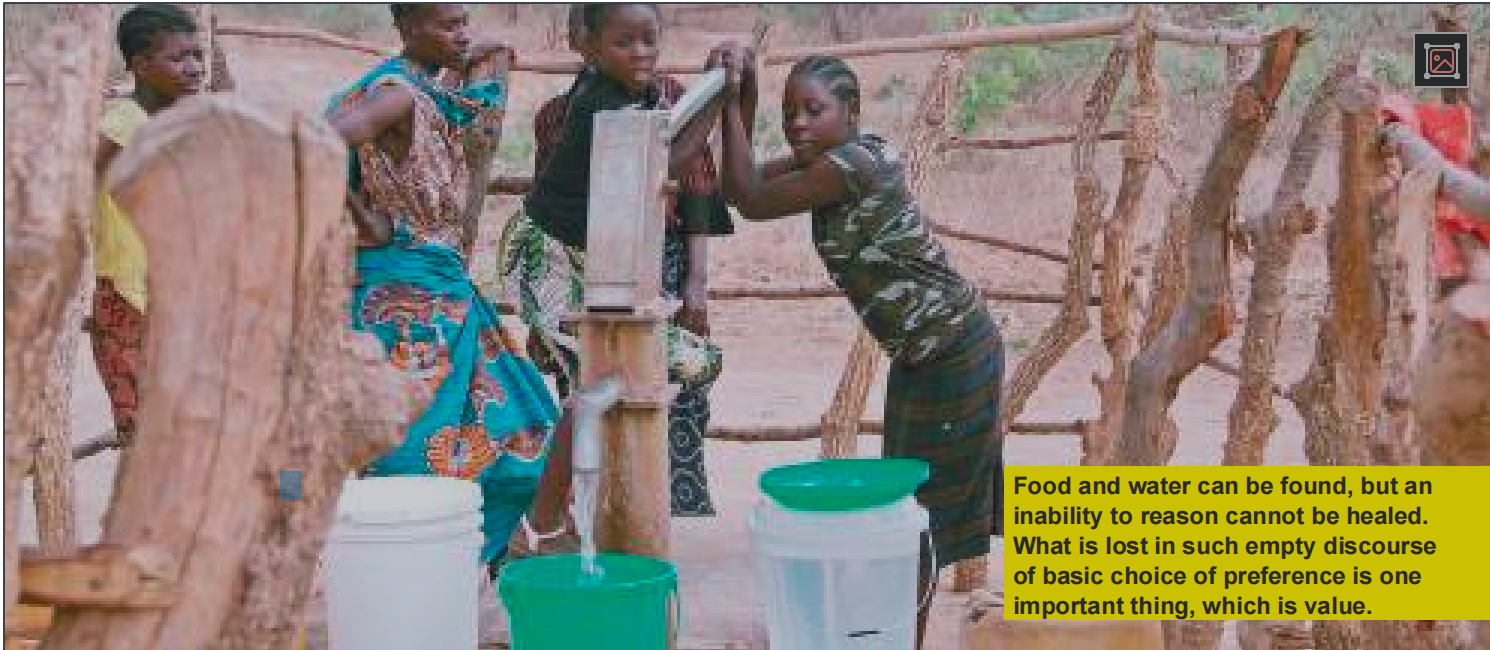
Food and water can be found, but an inability to reason cannot be healed. What is lost in such empty discourse of basic choice of preference is one important thing, which is value. 

That is, who gains value from these resources? And in the calculation of value, there must be evidence of ultimate beneficiary and the most efficient means of distribution. 

Each country will have its own successes and failures. Rich countries can post their success stories on how to distribute resources because they speak from a point of abundance. 

The real challenge occurs when resources are meagre because logic is never in permanence. This is part of the reason it becomes difficult to compare success stories of rich countries to poorer ones. Even worse, to contend that there is only one way to economic success. 

The reality is that money can flow in any system and adjust to prevailing systems of government. What matters most is how the state distributes those resources. 

Whichever inclination one prefers, the best solution is the one that makes the state accountable, or at least inclines public officers and elective positions to public scrutiny. 

This last point is the most overlooked achievement of the re-introduction of multi-party politics or democracy in Zambia in 1991. Simply that the State was rescued from being personal to becoming national. 

That the sovereign was not anymore, a person but a people. And those people will decide what mode of resource distribution best suits them. 

In this respect, since the state now belongs to the people, those with a socialist or capitalist-led manifesto must convince the owners of the state if nationalisation is better than liberalisation. 

In other words, the liberalised must decide if they choose continual economic emancipation or a return to national incarceration. Whatever the proclivity, the ultimate decision is one that that allows the people to have the last say and their interest must take centre stage. 

You Might Also Like

GET SCREENED AND TREATED TO AVERT TB DEATHS …As the deadly infectious disease continues to claim numerous lives

ZAMBIA: A CONTRADICTION OF INDEPENDENCE

PATHOLOGIES OF POLITICAL VIOLENCE

VACCINATION DOESN’T MEAN RELAXATION

Zambia should head for India’s marvel ARVs

Sign Up For Daily Newsletter

Be keep up! Get the latest breaking news delivered straight to your inbox.
By signing up, you agree to our Terms of Use and acknowledge the data practices in our Privacy Policy. You may unsubscribe at any time.
Share This Article
Facebook Copy Link Print
Previous Article GOV’T TO HELP CHISOKONE MARKET FIRE VICTIMS
Next Article CSOs caution gov’t over high cost of living

Stay Connected

235.3kFollowersLike
69.1kFollowersFollow
56.4kFollowersFollow
4.4kFollowersFollow
- Advertisement -
Ad imageAd image

Latest News

Stop the barbaric, violent political skirmishes – HRC
Local News News Politics Premium
August 7, 2026
Glasgow ‘Club’ Games contingent back
Local News
August 6, 2026
I am the best candidate for Chongwe West – Deka-Zulu
Local News Premium
August 6, 2026
HH condemns violence
Local News Politics Premium
August 5, 2026
//

We influence over 2 million readers and are the most preferred news platform in Zambia.

Quick Links

  • Politics
  • Court News
  • Health
  • Millennium TV

Top Categories

  • News
  • Local News
  • Politics
  • Health
  • Court News
  • Tie Business
  • Biz & Corporate

Sign Up for Our Newsletter

Subscribe to our newsletter to get our newest articles instantly!

Daily NationDaily Nation
Follow US
© 2026 Daily Nation Zambia. All Rights Reserved. Developed by GOPES.
  • Contact Us
  • Privacy Policy
Join Us!
Subscribe to our newsletter and never miss our latest news, podcasts etc..
Zero spam, Unsubscribe at any time.
Welcome Back!

Sign in to your account

Username or Email Address
Password

Lost your password?