

![[...]](https://secure.gravatar.com/avatar/9cad33b85e99b552b548e6ddd6afed37ad443a048e65e6ca5580ba0bef491764?s=120&d=mm&r=g)
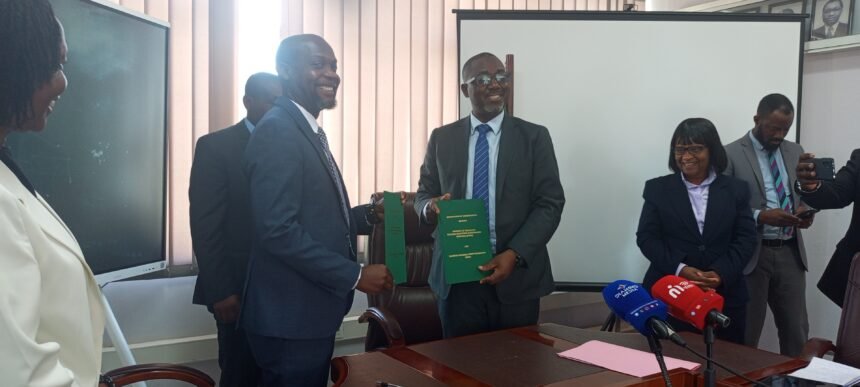
The Ministry of Education has signed a landmark Memorandum of Understanding (MoU) with the Zambian National STEM Foundation (ZNSF), marking a significant step towards strengthening science, technology, engineering and mathematics (STEM) education across Zambia.
This partnership is expected to enhance teacher capacity, expand practical STEM learning, establish innovation hubs and ensure that learners across the country acquire the skills required to drive Zambia’s industrialisation and economic transformation.
Speaking during the signing ceremony, Permanent Secretary for Educational Services Dr. Kelvin Mambwe said the agreement comes at a crucial time as Zambia continues implementing education reforms aimed at equipping learners with 21st-century knowledge and skills.

Dr. Mambwe commended the Zambian National STEM Foundation for its contribution to education through teacher training, innovation hubs and programmes that have inspired learners to embrace science and technology.
He said the Ministry’s curriculum reforms place greater emphasis on critical thinking, creativity, collaboration and practical skills, making the partnership with ZNSF essential in translating government policy into meaningful classroom practice.
The Permanent Secretary stressed that STEM education is central to Zambia’s future development, noting that sectors such as agriculture, healthcare, renewable energy and digital technology all depend on a workforce equipped with scientific knowledge and practical problem-solving abilities.
“When we talk about food security, we are talking about smart agriculture, irrigation technology and soil sensors,when we talk about healthcare, we are talking about medical devices, telemedicine and disease surveillance,all these begin in the classroom,” he said.
Dr. Mambwe emphasised that the partnership will expand STEM laboratories, robotics programmes, coding initiatives, science clubs and innovation competitions to schools across the country, particularly in rural and peri-urban communities.
He stressed that every child deserves equal opportunities regardless of where they live, saying learners in Shangombo should have the same opportunity to use modern technology such as 3D printers and robotics equipment as learners in Lusaka and other urban centres.
The Permanent Secretary further highlighted teachers as the foundation of successful STEM education, stating that even the best-equipped laboratories are ineffective without confident and well-trained educators.
He said the partnership will promote inquiry-based, hands-on teaching methods that move beyond traditional classroom instruction, enabling teachers to inspire curiosity and innovation among learners.
Dr. Mambwe also revealed that the programme will deliberately promote girls’ participation in STEM while ensuring that learners with special educational needs are fully included.
He said the initiative will create pathways from school science clubs to national science fairs and international Olympiads, with the goal of producing globally competitive Zambian innovators.
He added that classroom learning must be directly linked to employment, entrepreneurship and solving real-life challenges facing communities, adding that innovation competitions and partnerships with industry will help bridge the gap between education and the economy.
Dr. Mambwe reaffirmed government’s commitment to providing policy guidance, curriculum alignment and coordination through provincial, district and school leadership structures while creating an environment where innovation is encouraged and failure is viewed as part of the learning process.
Meanwhile, the Zambian National STEM Foundation described the Memorandum of Understanding as more than a formal agreement, calling it a long-term commitment to transforming education and preparing young people for the future.
The Foundation pledged to support continuous professional development for teachers, develop quality STEM learning materials, establish mentorship networks, undertake education research, mobilise private sector investment and organise national STEM competitions that inspire both teachers and learners.
further committing itself to working closely with the Ministry of Education over the next three years to ensure that STEM education becomes more practical, accessible and inclusive across Zambia.
The partnership is expected to strengthen Zambia’s education system by producing learners who are innovators, entrepreneurs and problem-solvers capable of developing local solutions to national challenges while contributing to the country’s long-term development agenda.